Choosing the right marketing automation platform is not just about features. It is about picking the tool that fits your business model, team structure, and data needs. Both platforms help automate campaigns and improve customer journeys, but they are built differently.
HubSpot is known as a broad all-in-one platform. It combines CRM, marketing, sales, service, content, and reporting tools in one ecosystem. Ortto is more focused on customer data, lifecycle marketing, analytics, and omnichannel automation. For some businesses, HubSpot is the smarter investment because it gives multiple teams one shared system. For others, Ortto is the better choice because it offers specialized lifecycle marketing power without the weight of a larger suite.
Choosing between Ortto and HubSpot in 2026 is no longer just a choice between two email tools; it is a choice between two fundamentally different business philosophies. On one side, you have HubSpot, the titan of the “All-in-One” CRM ecosystem. On the other hand, you have Ortto, the agile, data-first “Customer Data Platform” (CDP) designed to unify your entire tech stack
Ortto vs HubSpot at a Glance
HubSpot is best for businesses that want one connected platform across marketing, sales, service, and CRM. Ortto is best for businesses that want customer data driven automation with strong journey building and lifecycle engagement tools.

If your company wants a single platform where marketing, sales, and customer success can work together, HubSpot usually has the advantage. If your team already has a CRM and wants a platform focused on segmentation, automation, analytics, and cross-channel journeys, Ortto often stands out.
| Feature | Ortto (CDP-First) | HubSpot (CRM-First) |
| Core Strength | Unifying data from multiple apps (Stripe, SaaS, DBs). | All-in-one sales, marketing, and service alignment. |
| AI Capabilities | AI Decision Shapes & Natural Language Filters. | “Breeze” AI Agents & Copilot across all Hubs. |
| Automation | Visual “Canvas” for complex, event-based journeys. | Robust “Workflows” based on CRM property changes. |
| Best For | SaaS, E-commerce, and data-heavy startups. | Mid-market to Enterprise B2B organizations. |
| Starting Price | ~$199/month (approx. 5k contacts). | $15/month (Starter) to $890/month (Professional). |
What is the Difference Between Ortto and HubSpot?
Ortto is built around customer data and lifecycle marketing. It helps businesses unify customer information, segment audiences deeply, build behavior-based journeys, and engage people across channels. It is especially appealing to SaaS companies and teams that rely on event-based user behavior.
HubSpot is built as a broader customer platform. Marketing automation is a major part of its value, but it also includes CRM, sales tools, service tools, content features, forms, landing pages, and website capabilities. That makes it attractive for companies that want one system for multiple departments.
In simple terms, Ortto starts with customer lifecycle automation. HubSpot starts with a larger business ecosystem.
Feature Comparison: Ortto vs HubSpot
When comparing Ortto vs HubSpot, the key question is not which one has more features overall. It is which feature set matches how your business operates.
1. The Core Philosophy: CDP vs. All-in-One CRM
The most significant difference lies in how these tools view your data.
Ortto: The Data Orchestrator
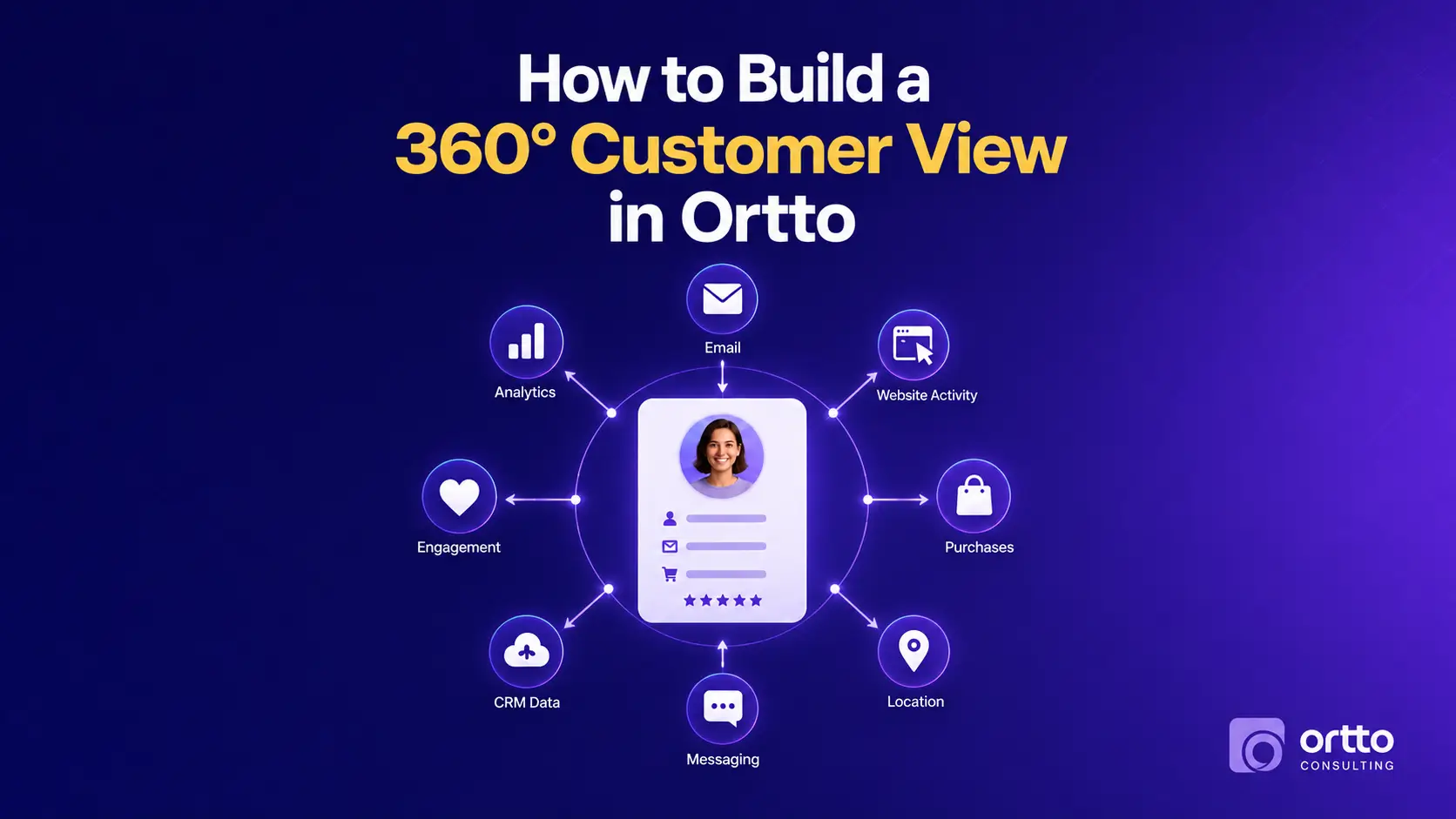
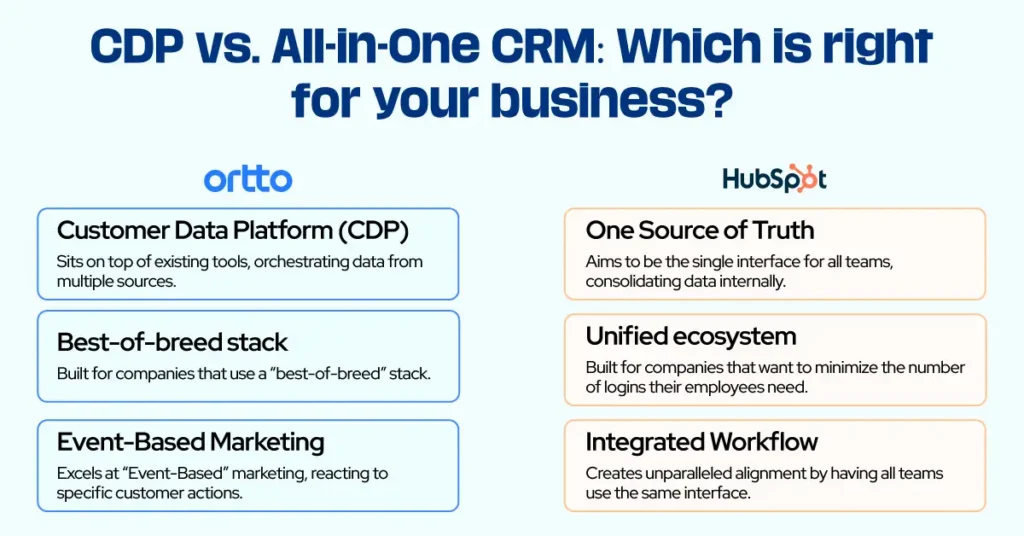
Ortto (formerly Autopilot) was rebuilt from the ground up to be a Customer Data Platform(CDP). It doesn’t want to replace your entire stack; it wants to sit on top of it. Ortto excels at “Event-Based” marketing. If a customer cancels a subscription in Stripe, triggers a support ticket in Zendesk, and visits a specific pricing page, Ortto unifies these three separate events into one profile instantly. It is built for companies that use a “best-of-breed” stack.
HubSpot: The Unified Ecosystem
HubSpot operates on a “One Source of Truth” model. It wants your sales team, your marketing team, and your support team all using the same interface. This creates unparalleled alignment. When a lead moves from “Marketing Qualified” to “Sales Discovered,” the transition is seamless because there is no integration needed; it’s the same database. HubSpot is built for companies that want to minimize the number of logins their employees need.
2. AI Capabilities (Breeze vs. AI Journey Builder)
In 2026, AI is no longer a “feature” , it is the engine. Both platforms have made massive strides here.
HubSpot’s “Breeze” AI
HubSpot recently launched Breeze, a comprehensive AI layer that includes:
- Breeze Agents: Autonomous workers for content, social media, and prospecting. The Prospecting Agent acts like a 24/7 BDR, researching and emailing leads based on buyer intent signals.
- Breeze Copilot: An assistant that lives inside your CRM to summarize records, draft emails, and even update CRM properties through natural language.
- Intelligence: A data-enrichment tool that automatically fills in company details and buyer intent.
Ortto’s AI Journeys
Ortto has focused its AI on Efficiency and Decisions:
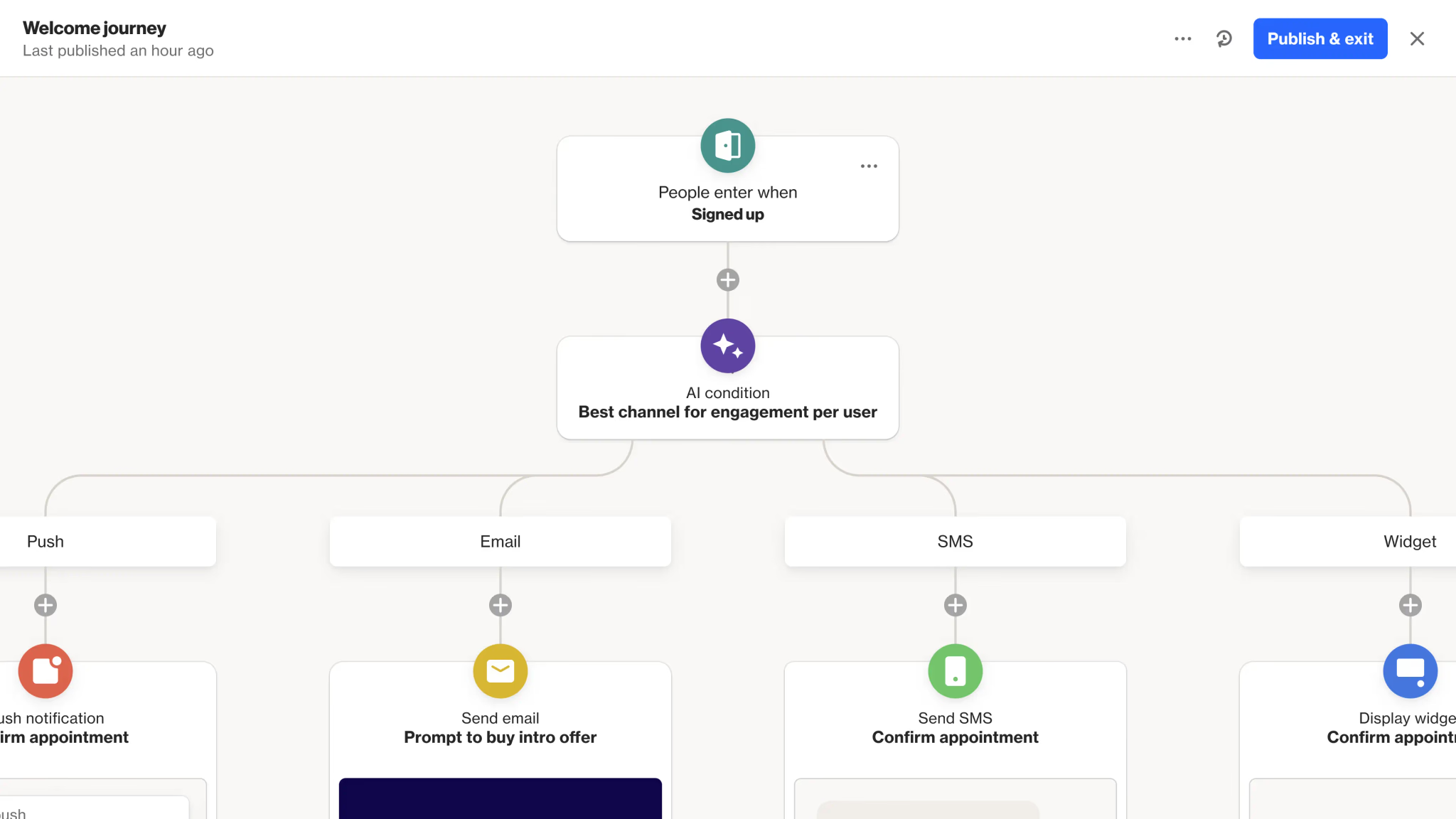
- AI Decision Shapes: Instead of manually setting up “If/Else” logic, you can prompt Ortto’s AI: “Only send this discount to users who are 80% likely to churn.” The AI analyzes your historical data and creates the path for you.
- Natural Language Filters: You no longer need to be a SQL expert to segment your list. You can simply type, “Show me users in New York who haven’t logged in for 30 days,” and Ortto builds the segment instantly.
3. Marketing Automation & Journey Mapping
The Visual Journey Builder (Ortto)
Ortto’s canvas is arguably the most intuitive in the industry. It feels like a digital whiteboard. You can drag and drop “shapes” to create complex paths. Because Ortto is a CDP, its triggers are more granular. You can trigger a journey based on a custom event (e.g., “User clicked ‘Export’ more than 5 times in 10 minutes”). This makes it the go-to for Product-Led Growth (PLG) strategies.
Workflows (HubSpot)
HubSpot’s workflows are list-based and highly structured. While they lack the “whiteboard” feel of Ortto, they are incredibly powerful for B2B sales cycles. You can automate internal tasks like rotating leads to sales reps or updating a deal stage with massive reliability. However, connecting HubSpot to external “product data” (like what a user is doing inside your software) often requires the expensive Operations Hub.
4. Data Management & Reporting
SaaS & E-commerce Metrics (Ortto)
If you care about MRR (Monthly Recurring Revenue), LTV (Lifetime Value), and Churn Rate, Ortto is superior. It treats revenue data as a first-class citizen. You can create dashboards that show exactly how much revenue a specific email campaign generated, pulling that data directly from your payment processor (Stripe/Recurly).
Attribution & Pipeline Reporting (HubSpot)
HubSpot is the king of Multi-Touch Attribution. It can show you every touchpoint a lead had from the first Google search to the final signed contract. Its reporting is designed for the “Revenue Operations” (RevOps) professional who needs to prove the ROI of the marketing department to the CEO.
5. Integrations & Ecosystem
The “Plug and Play” Model (Ortto)
Ortto’s integration library is focused on “Data In / Data Out.” It plays exceptionally well with Segment, Snowflake, and BigQuery. If your data lives in a warehouse, Ortto can talk to it natively. It’s designed for the modern “Composable Stack.”
The Marketplace (HubSpot)
HubSpot has over 1,500 integrations in its marketplace. However, be warned: many “native” integrations are basic. For advanced bi-directional syncing, you often find yourself needing third-party tools like PieSync (now part of HubSpot) or costly upgrades to their Operations Hub. HubSpot wants to be the sun in your solar system; other apps are just planets.
6. The “Price Cliff” Comparison
This is where the decision usually gets made.
The HubSpot Pricing Reality
HubSpot’s “Starter” plans are incredibly affordable ($15–$20/month). However, once you need professional automation or A/B testing, you hit the Professional Tier, which jumps to $890/month.
- Mandatory Onboarding: HubSpot usually requires a one-time onboarding fee ($3,000 for Professional).
- The Contact Tax: HubSpot charges heavily as your database grows. 10,000 contacts on HubSpot Marketing Hub Professional can easily exceed $1,200/month.
The Ortto Pricing Model
Ortto is generally more affordable for mid-sized companies. Their pricing scales more linearly based on “Records” (contacts) and “Activities.”
- No Forced Onboarding: You can set it up yourself or hire a partner, but there is no mandatory $3k fee.
- SaaS Friendly: Because it’s built for SaaS, they understand that a “contact” who hasn’t logged in for 3 years shouldn’t cost you the same as an active lead.
Pricing Comparison
Understanding the pricing of these two platforms is often the “make or break” moment for businesses. While HubSpot looks cheaper at the entry level, it can become significantly more expensive as you scale. Ortto, conversely, has a higher entry point but more predictable growth costs.
Here is the breakdown of Ortto vs. HubSpot Marketing Hub pricing for 2026.
1. Plan-by-Plan Comparison
| Pricing Tier | Ortto (CDP-First) | HubSpot (CRM-First) |
| Free Tier | ❌ None (14-day free trial) | ✅ Free tools (limited automation) |
| Starter | $199/mo (Up to 5k-10k contacts) | $15/mo per seat (Starts at 1k contacts) |
| Professional | ~$599/mo (Up to 10k contacts) | $890/mo (Starts at 2k contacts) |
| Enterprise | Custom | $3,600/mo (Starts at 10k contacts) |
| Mandatory Fees | ✅ $0 (Self-onboarding) | ⚠️ $3,000 – $7,000 (Onboarding fee) |
2. Hidden Costs & The “Price Cliff”
When comparing these two, you must look beyond the monthly sticker price.
HubSpot’s “Contact Tax”
HubSpot’s pricing is notorious for the “Professional Tier Jump.” * The Jump: Moving from Starter ($15) to Professional ($890) is a massive leap. This is where most small businesses get stuck.
- The Onboarding Fee: You cannot skip the onboarding fee for Professional ($3,000) or Enterprise ($7,000) tiers. Even if you are an expert, you have to pay it.
- Additional Contacts: In the Professional tier, adding 5,000 more contacts usually adds $250/mo to your bill.
Ortto’s Unified Data Model
Ortto is built as a Customer Data Platform (CDP).
- Unified Records: Unlike HubSpot, which charges you for “Marketing Contacts,” Ortto looks at your total data.
- Self-Service: There are no forced onboarding fees. You can be up and running in a few hours using their native integrations (Stripe, Segment, etc.).
- Predictable Scaling: While the starting price of $199 is higher than HubSpot’s $15, you get much more power (full automation, multi-channel journeys) right out of the gate.
3. Cost at Scale (10,000 Contacts)
Example: A growing SaaS company with 10,000 contacts needing professional automation.
- Ortto (Professional): Approx. $599/mo
- Includes: 10,000 contacts, visual journeys, AI suggestions, and SMS capabilities.
- HubSpot (Marketing Professional): Approx. $1,390/mo
- Breakdown: $890 (base) + $500 (extra contact increments) + $3,000 (one-time onboarding fee).
Pros and Cons of Ortto vs HubSpot
Ortto
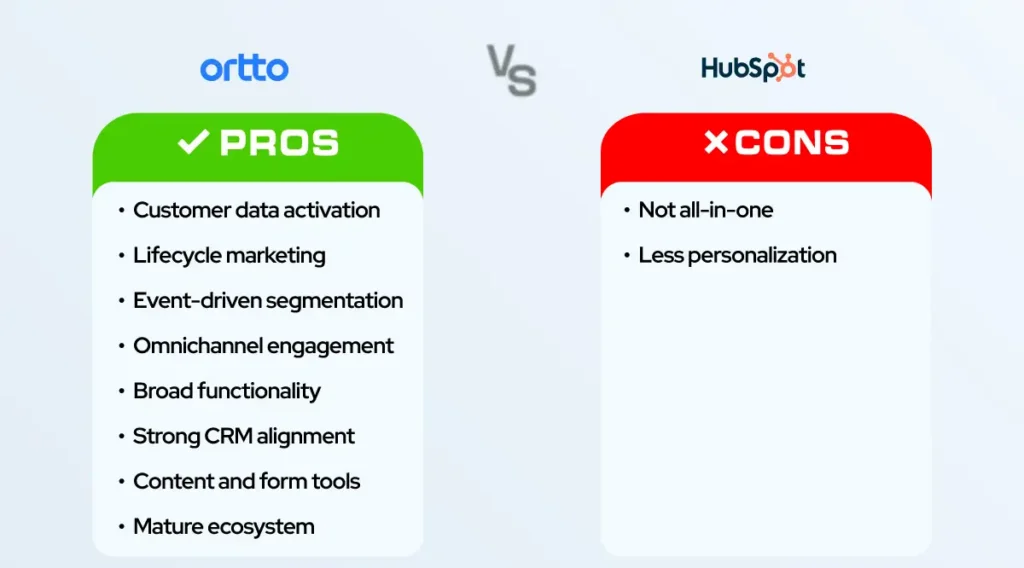
Ortto is strong in customer data activation, lifecycle marketing, event-driven segmentation, and omnichannel engagement. It can be an excellent fit for SaaS and subscription companies that care about user behavior, retention, and personalization. The tradeoff is that it is not an all-in-one business platform.
Hubspot
HubSpot offers broad functionality, strong CRM alignment, content and form tools, and a mature ecosystem. It is one of the best platforms for businesses that want marketing, sales, and service connected in one place.
Who Should Choose Ortto?
Ortto is a strong choice for businesses that already have a CRM or broader stack in place and want better lifecycle marketing capabilities. It is especially well suited for SaaS companies, subscription brands, product-led businesses, and teams that rely on customer events and behavior for segmentation.
Who Should Choose HubSpot?
HubSpot is a strong choice for businesses that want one connected platform for CRM, marketing, content, lead generation, sales alignment, and customer management. It is especially effective for SMBs, B2B companies, agencies, and growing teams that want operational simplicity across departments.
Final Verdict: Which Marketing Automation Tool Wins?
There is no single winner in the Ortto vs HubSpot comparison because the better platform depends on what your business needs.
Choose Ortto if your priority is customer data, lifecycle automation, behavioral segmentation, and omnichannel engagement. It is the better option for teams that want focused sophistication in customer journeys.
Choose HubSpot if your priority is an all-in-one ecosystem that connects CRM, marketing, content, sales, and reporting. It is the better option for companies that want cross-functional growth in one platform.
If you want the best specialized lifecycle marketing tool, Ortto wins. If you want the best all-in-one growth platform, HubSpot wins.
.